Ribbon Cutting Ceremony: Meaning, Steps and Ideas
- Author: Ribbon Cutting Desk Editorial Team
- Posted
- In Ribbon Cutting
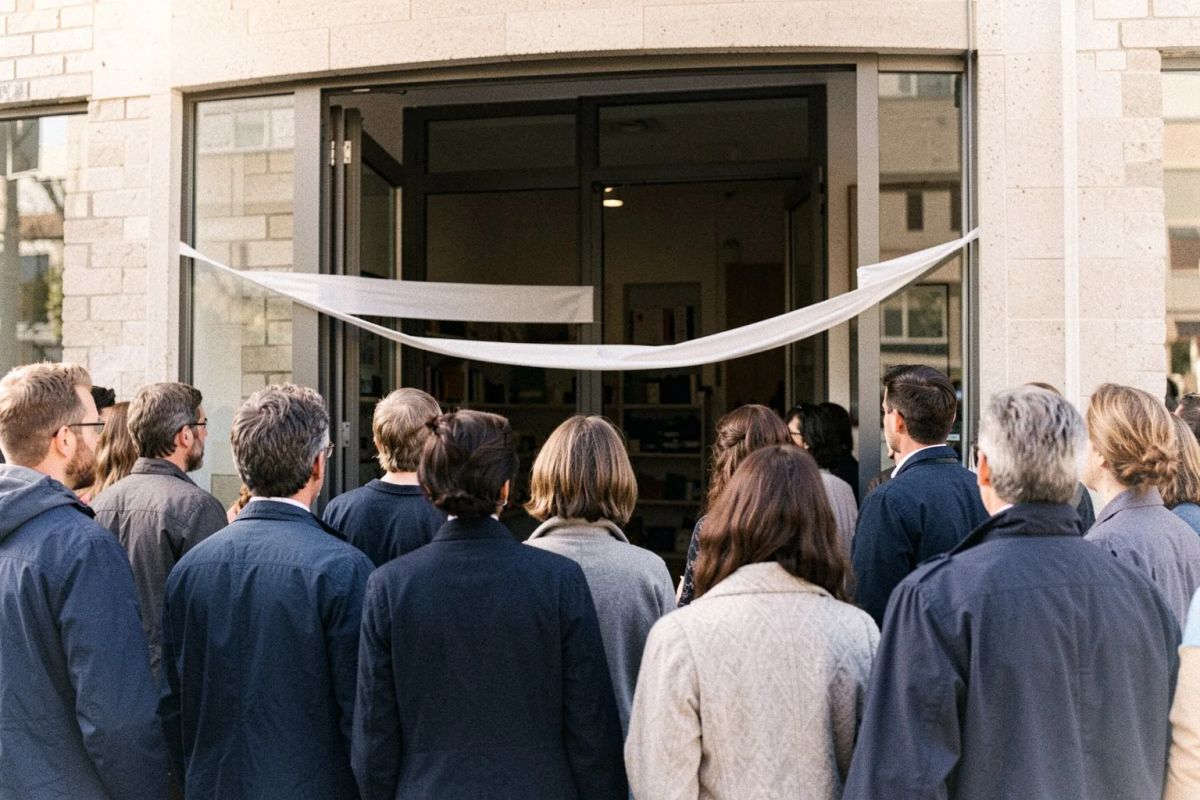
A ribbon cutting ceremony is a short public event that marks the official opening of a business, building, park or project. A host welcomes guests, a few people speak, and a chosen group makes the symbolic cut together while a photographer records it. Most ceremonies are brief, and the planning lies in the order and the people, not the props.
Cue-checked by the Ribbon Cutting Desk team: each fact above was matched to a source this page cites.
A ribbon cutting ceremony is the short public moment that says “we are open.” If you want the plain definition and the meaning behind the ritual, start with the plain definition and meaning. This page is the full guide to how one actually runs: who takes part, the order of events, timing, the types of ceremony and the mistakes that cause awkward minutes in front of a crowd.
What is a ribbon cutting ceremony?
A ribbon cutting ceremony is a brief event in which a host, a few speakers and a small cutting party mark the official opening of a place or project, ending with a symbolic cut that everyone can see and photograph. The cut is the punctuation mark. The ceremony around it is a welcome, a few words of thanks and a shared moment.
The ceremony can be tiny or large. A one-person shop might gather twenty neighbours; a public library might gather officials, staff and a crowd. The structure is the same either way.
Why do organizations hold one?
Organizations hold a ribbon cutting to give an opening a clear start, to thank the people involved, and to invite the community in at the same moment. It also produces a record: the photos and the date can be reused in announcements and newsletters afterwards.
Practical reasons organizers give:
- A defined start. Guests, press and staff all know when the place is officially open.
- A reason to invite officials and partners. People are more likely to attend a specific, short event than a vague open invitation.
- Shared recognition. A ceremony lets the host thank funders, builders, staff and neighbours in public.
- A photo. The cut is one of the few moments that is both symbolic and easy to capture. See ribbon cutting photos for the shot list.
Many local chambers of commerce take part in member ribbon cuttings, because chambers exist to support local businesses through networking and publicity. The U.S. Chamber of Commerce describes a chamber as a regional organization of local businesses that support the interests of its members. If your chamber offers this, how a chamber ribbon cutting works explains the usual routes. Rules and member programs differ by chamber, so check the chamber’s own pages.
Who takes part?
Six roles cover almost every ceremony. One person can hold more than one role at a small event.
| Role | Job on the day |
|---|---|
| Host | Owns the event, welcomes guests, introduces speakers |
| Master of ceremonies | Runs the order of events and gives the cues (often the host) |
| Speakers | Give short remarks, usually two or three |
| Cutting party | The people who make the cut together, often a handful of people (editorial example) |
| Photographer | Captures the cut, the group and the crowd |
| Greeter or helper | Welcomes arrivals, points to parking, restrooms and accessible routes |
Choose the cutting party for meaning, not rank alone. Include the people the day is really about: the owner or project lead, the main funder or partner, a local official, and someone from the team that did the work. Brief each person before the event on where to stand, who holds what, and when the cue will come.
How does the ceremony run, step by step?
Most ceremonies follow six steps, from the host’s welcome to the closing invitation to enter. The sequence below is an editorial example, not a rule; adapt it to your guest list. For a minute-by-minute version, use the ribbon cutting run of show.
- Welcome. The host greets guests, says why everyone is here and names the place or project.
- Thanks and introductions. Acknowledge the officials, partners and teams by name. Keep it to the people who matter to the day.
- Remarks. Two or three speakers, each short. The most senior or most connected guest typically speaks last, just before the cut.
- Line-up. The master of ceremonies invites the cutting party forward and positions them. Take a moment to check that guests can see and that the photographer has a clear line.
- The cut. A short countdown or a simple “on three” cue, then the cut. Pause for applause and photographs; people want a second to enjoy it.
- Open and invite. The host thanks everyone, invites guests inside or onto the site, and tells them what happens next, such as a tour or refreshments.
Words for steps 1 to 6 are in the script page, written as fill-in sample wording.
Where do people stand?
Put the ribbon in front of the thing being opened, with guests facing it and the sun behind the audience if you can. The cutting party stands behind the ribbon in a shallow curve so each face is visible. Speakers use a spot to one side so they do not block the view of the entrance.
Leave an aisle for people who use wheelchairs, walkers or strollers, and make sure the route from parking to the ceremony area is clear. The photographer should stand where the building or sign appears behind the cutting party; more on that in the photo guide.
How long does a ribbon cutting take, and when should you schedule it?
The program itself is short. As an editorial planning example, a simple ceremony runs about 15 minutes and a ceremony with several speakers about 30. Add time before for arrivals and after for photos and conversation, because guests linger.
Scheduling guidance that needs no statistics:
- Pick the time for your key guests first. Officials and sponsors have the least flexibility. Confirm with them before you tell anyone else.
- Think about light. Midday sun creates hard shadows; morning or late afternoon is kinder to faces. If the entrance faces away from the sun, you gain flexibility.
- Avoid collisions. Check local events, school pickup and rush hour.
- Build a buffer. Ceremonies rarely start on the minute. Plan to start a few minutes late and still end on time.
Outdoor ceremonies need a weather plan. The National Weather Service says that if you hear thunder you are likely within striking distance of the storm and that there is no safe place outside when thunderstorms are in the area. Name an indoor fallback and a person who will make the call. The full planning steps, including permits and accessibility, are in how to plan a ribbon cutting ceremony.
What types of ribbon cutting ceremony are there?
Ceremonies differ mostly by who hosts them and who comes. The steps stay the same; the guest list, tone and length change.
| Type | Typical host | Typical guests | Tone |
|---|---|---|---|
| Business opening | Owner | Customers, neighbours, chamber members | Warm, short |
| Public building or park | Agency or council | Officials, residents, press | Formal, several speakers |
| Nonprofit or faith community | Staff or board | Members, donors, volunteers | Thankful, community-focused |
| Project completion | Project manager | Builders, partners, funders | Recognition-led |
More detail on each setting is in ribbon cutting events by type. If your event is the start of construction rather than an opening, see the groundbreaking guide instead.
How do you make it accessible?
Make the ceremony usable for everyone before you announce it. The ADA says covered entities must communicate effectively with people who have communication disabilities and provide aids and services when needed. If your host is a public body or a business open to the public, ask what that means for your event rather than assuming.
Practical steps:
- Tell guests in the invitation how to ask for help, such as a sign language interpreter or captioning, and give a contact and a reasonable deadline.
- Share the speaker order and any printed remarks on request.
- Use a microphone for remarks, and tell the speaker to face the audience.
- Place seating and the viewing area on a route that does not rely on stairs.
This is general information, not legal advice. Check the ADA site and your local rules for what applies to you.
What are the most common mistakes?
Most ceremony problems are small and avoidable.
- Too many speakers. Each one adds time, and the crowd’s attention drops. Cap speakers and give each a time limit.
- No cue. The cutting party stands waiting while the host searches for the moment. Agree on the cue words in advance.
- Photographer blocked. Guests step into the shot. Ask guests to stay behind a marked line.
- Unannounced guests of honor. An official arrives and nobody introduces them. Assign a greeter to meet VIPs.
- No weather plan. Rain or a storm arrives and no one can decide. Name the fallback and decision-maker in advance.
- Forgetting to invite people in. The cut happens and everyone stands still. End with a clear next step.
- Permit surprises. If the ceremony is on public property or closes a street, ask your city early. For example, the City of Orlando says a special event permit is required when more than 100 people will attend an event on city property, with applications due at least 60 days before. Other cities set different rules, so check yours.
Where do you go next?
Work through the pages in order of need:
- How to plan a ribbon cutting ceremony: the checklist and roles.
- Ribbon cutting run of show: a timed program you can copy.
- Sample wording for each speaker: sample words for each speaker.
- Ribbon cutting invitation wording: what the invitation must say.
- Formats beyond the standard cut: formats beyond the standard cut.
- Ribbon cutting photos: the shot list and positions.
- Where the cut sits inside an opening day: where the cut sits inside an opening day.
- The ceremony program builder turns your inputs into a timed program.
All Ribbon Cutting guides
- Chamber of Commerce Ribbon Cutting: How It Works
How a chamber of commerce ribbon cutting usually works, with examples from two chamber pages: who can request one, notice, roles and questions to ask.
- Grand Opening Ribbon Cutting: Where It Fits in the Day
Where a ribbon cutting fits inside a grand opening day: before, during and after the cut, who to invite, timing for photos and a weather backup plan.
- Ribbon Cutting Ceremony Ideas and Creative Alternatives
Ideas for a ribbon cutting ceremony: group cuts, themed openings and symbolic alternatives, plus access tips and a quick table for choosing.
- Ribbon Cutting Etiquette: What to Wear and Bring
What to wear, when to arrive, where to stand and whether to bring a gift or flowers to a ribbon cutting, for guests, speakers and hosts.
- Ribbon Cutting Events: Business, Office, Church and Park
How a ribbon cutting differs for a business, office, public building, park or church: tone, guest list, speakers and what to plan for each.
- What Is a Ribbon Cutting Ceremony? Meaning and Purpose
What a ribbon cutting ceremony is, what the cut symbolises, why organizations hold one, and how it differs from a grand opening or open house.
People also ask
What is the purpose of a ribbon cutting ceremony?
The purpose is to mark a clear, shared moment when a place or project officially opens. It gives the host a reason to invite the community, thank the people who made it happen, and create a photo that tells the story. Guests get a defined start, and the organization gets a public record of the day it opened.
Who usually cuts the ribbon?
The host decides, and the choice is symbolic. Common groups include the owner or project lead, a local official, a chamber representative, a major sponsor and one or two guests of honor. Keep the cutting party small enough to fit in one photo frame, and brief each person on where to stand and when the cue comes.
How long does a ribbon cutting ceremony take?
Plan on roughly 15 to 30 minutes for the program itself, as an editorial planning example rather than a rule. A short ceremony has a welcome, two or three speakers, the cut and thanks. Add time before for arrivals and after for photos and informal conversation, since guests rarely leave the moment the cut is done.
Is a ribbon cutting the same as a grand opening?
No. A ribbon cutting is one moment of ceremony; a grand opening is the wider day or period when a place opens to the public, and it may include a ribbon cutting. Many organizations hold the ribbon cutting at the start of an open house or opening day. Planning for the rest of that day is a separate subject.
Do you need a speech?
No, but a few spoken words make the event feel intentional. At minimum, a host should welcome guests, name the people involved and announce the cut. Two or three short remarks, each under a few minutes, are usually enough. If nobody wants to speak, a single host welcome and thank-you works well.
What time of day works best?
Choose a time when your key guests can attend and the light suits photos. Mid-morning, late morning or the start of the lunch period are common choices, and early evening works for community events. Avoid times that clash with rush hour or with the hours your guests of honor are working. Confirm the time with the officials first.
Our sources
- What Is a Chamber of Commerce? (U.S. Chamber of Commerce) (uschamber.com)
- Lightning Safety (National Weather Service) (weather.gov)
- Effective Communication (ADA.gov) (ada.gov)
- Events on Public Property (City of Orlando) (orlando.gov)
Related guides
- Chamber of Commerce Ribbon Cutting: How It Works
How a chamber of commerce ribbon cutting usually works, with examples from two chamber pages: who can request one, notice, roles and questions to ask.
- Grand Opening Ribbon Cutting: Where It Fits in the Day
Where a ribbon cutting fits inside a grand opening day: before, during and after the cut, who to invite, timing for photos and a weather backup plan.
- Ribbon Cutting Ceremony Ideas and Creative Alternatives
Ideas for a ribbon cutting ceremony: group cuts, themed openings and symbolic alternatives, plus access tips and a quick table for choosing.
- Ribbon Cutting Etiquette: What to Wear and Bring
What to wear, when to arrive, where to stand and whether to bring a gift or flowers to a ribbon cutting, for guests, speakers and hosts.
- Ribbon Cutting Events: Business, Office, Church and Park
How a ribbon cutting differs for a business, office, public building, park or church: tone, guest list, speakers and what to plan for each.
- What Is a Ribbon Cutting Ceremony? Meaning and Purpose
What a ribbon cutting ceremony is, what the cut symbolises, why organizations hold one, and how it differs from a grand opening or open house.