Ribbon Cutting Ceremony Script and Speech Examples
- Author: Ribbon Cutting Desk Editorial Team
- Posted
- In Planning Run Of Show
A ribbon cutting script has five parts: a host welcome, remarks by the owner or sponsor, remarks by a guest or official, a countdown and cut, and closing thanks. Fill in the placeholders in the sample wording below, keep each speaker to one or two minutes, and read it aloud once before the day so it sounds like you.
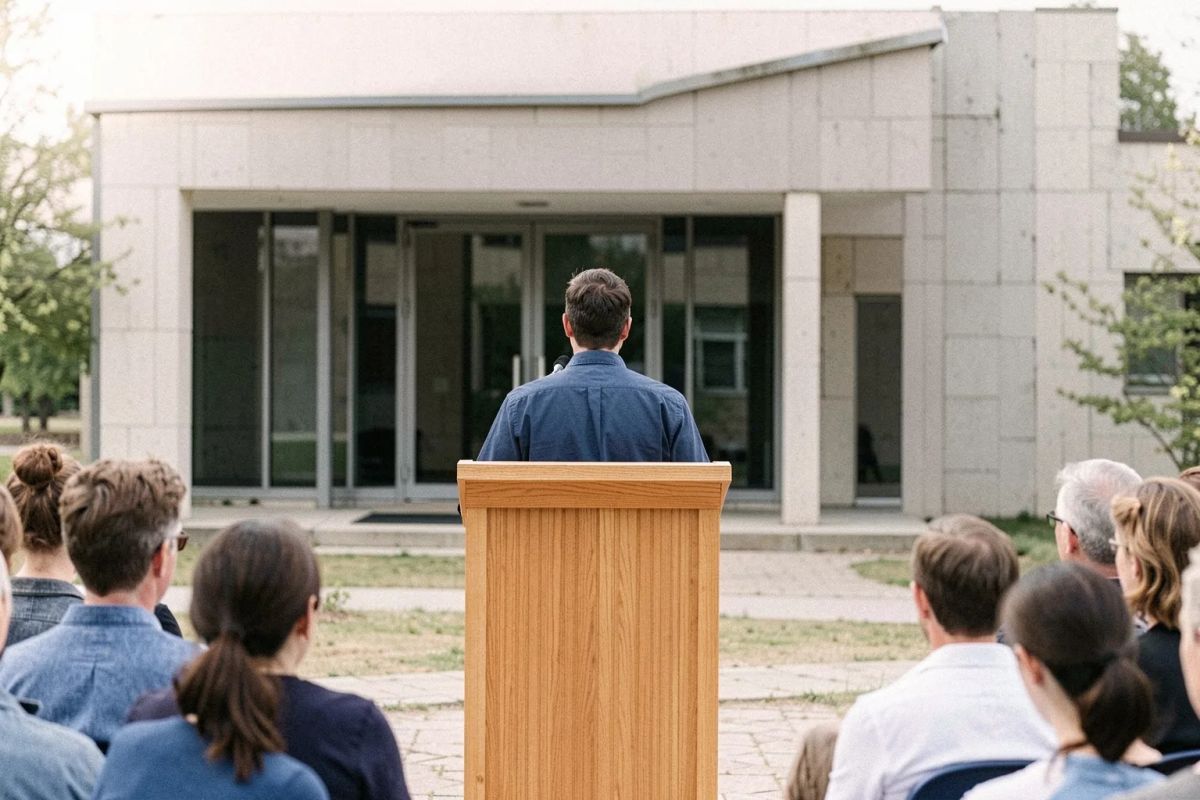
Section of: How to Plan a Ribbon Cutting Ceremony: Checklist
All wording below is original sample text. Replace anything in [brackets] with your own details. The structure follows the plan for a ribbon cutting ceremony, and the timing sits in the run of show. If you only need an outline you can fill in, use the ceremony speech outline tool.
How do you structure a ribbon cutting speech?
Use five parts in this order: welcome, thanks, remarks, the cut and the close. Each part has one job. Welcome tells people where they are; thanks names those who helped; remarks give the reason; the cut is the ritual; the close tells people what to do next.
Rules that help every speaker:
- One idea per speaker. If a speaker has three points, they need three minutes.
- Say names slowly and spell hard ones for the host in advance.
- Look up, not down. Write the script in large type.
- End on a clear sentence, so the host knows when to step in.
What does the host welcome sound like?
The host says who is welcome, what is happening and why it matters. The formal version suits a public building; the warm version suits a small business.
Formal sample
“Good [morning/afternoon], and welcome. My name is [name], and I am [role] at [organization]. We are here today to open [name of place or project] to [the public / our community]. I would like to thank [officials and partners] for joining us. In a few moments we will hear from [speaker 1] and [speaker 2], and then we will open the doors together.”
Warm sample
“Hello, everyone, and thank you for coming. I am [name]. Today is a big day for [organization], and we are glad you are here for it. We will keep this short. A few words, a few thank-yous, and then we will cut the ribbon and invite you in.”
Housekeeping line (optional)
“A quick note before we start: [restrooms are … / parking is … / if you need any assistance, please see [name] at the front].”
Weather line, if needed
“If the weather changes, we will move inside to [location]. [Name] will let us know.”
What does the owner or sponsor say?
The owner or sponsor tells the story of why the place exists and thanks the people who helped. Keep it personal and specific, with one or two names and one short reason. Avoid claims about numbers or history you cannot support; stay with what you know.
Sample, one to two minutes
“Thank you, [host]. A few years ago, [organization] was an idea. Today it is [a real place]. I want to thank [name of partner or team] for [specific contribution]. I want to thank [name] for [specific contribution]. And I want to thank everyone here, because you are the reason we built it. We hope [place] will be [useful/welcoming/a good neighbour] for a long time. Now let us open it.”
Sixty-second version
“Thank you all for being here. [Organization] exists because of [name], [name] and the team who worked so hard to bring it here. I am proud of what they have done, and I am glad you are here to see it. Welcome.”
What does an official or guest of honor say?
An official or guest of honor adds recognition and a link to the wider community. Ask them to keep to the time limit and give them the host’s introduction in advance so the introduction matches their title.
Sample, one to two minutes
“Thank you, [host]. On behalf of [office or organization], congratulations to everyone who made this possible. [Place] will serve [who it serves], and it shows what [community] can build when people work together. I am glad to be part of today, and I look forward to seeing it in use. Congratulations.”
Do not script real quotes from named officials; write the sample and let them edit it to their own voice.
How do you give the countdown and the cut?
Invite the cutting party forward, give one sentence of meaning, then count. The aim is a shared beat, so guests and photographer know exactly when it happens.
“Would [names or: the cutting party] please join me at the ribbon. [Pause while they line up.] Thank you. With the people who made today possible, we now declare [name] open. On three: one, two, three.”
Notes for the host:
- Wait until the cutting party is in position and facing the audience.
- Tell the party in advance whether they cut on “three” or after it.
- After the cut, say nothing for a few seconds. Let applause and photos happen.
How do you close the ceremony?
The closing says thank you and tells guests what to do now. Do not leave people standing; give them a clear next step.
Sample
“Thank you all for coming. Please join us [inside / at the front table] for [refreshments, a look around, a tour]. [Name] and the team will be glad to show you around. Please follow [the signs / our helpers]. Welcome to [place].”
What are short versions for a very small ceremony?
A sixty-second ceremony needs only three sentences.
“Welcome, everyone, and thank you for coming. [Place] is open because of [name], [name] and all of you. Let us cut the ribbon together: one, two, three.”
A two-minute version adds one thank-you and one remark from the owner. Anything longer should be rehearsed.
How do you adjust the tone and make it accessible?
Match the wording to the room. A formal ceremony uses full names, titles and complete sentences. A warm ceremony uses first names and shorter lines. In both, avoid jargon and inside jokes.
On access, the ADA says covered entities must communicate effectively with people who have communication disabilities and provide aids and services when needed, and that sign language interpreters are effective only for people who use sign language. So offer the script in print or by captioning in advance, in addition to any interpreter, and put the request process in the invitation; see ribbon cutting invitation wording. If the weather turns, the weather lead should interrupt: the National Weather Service says that if you hear thunder you are likely within striking distance of the storm.
For the full picture of the event, read the overall ceremony guide. For a project that starts rather than opens, use the groundbreaking speech page.
People also ask
What do you say at a ribbon cutting?
Welcome guests, say why you are all there, thank the people involved, give a few short remarks, then count down and cut. A good host names the place, the date and one thing the guests are celebrating. Keep the words plain, speak slowly and finish with a clear invitation, such as asking everyone to come in and look around.
How long should the speech be?
Short. A host welcome of one to two minutes and remarks of one to three minutes each are enough for most ceremonies; these are editorial guidelines, not rules. If a speaker has more to say, invite them to say it in conversation afterwards. Crowds at an outdoor event lose attention fast, so stay inside the time limit.
How do you introduce the cut?
Invite the cutting party forward, thank everyone for being there, say what the cut means in one sentence, then give the countdown. For example: 'With the people who made this possible, let us open the doors.' Make sure the cutting party knows whether to cut on the final word or just after it.
Do you need a countdown?
No, but it helps the crowd and the photographer. A countdown from three gives everyone one shared beat and avoids a ragged, half-hearted cut. If you skip it, use a clear verbal cue such as 'Please cut the ribbon now.' Practise it once with the cutting party, so nobody is surprised.
Can the script be bilingual?
Yes. If your community speaks more than one language, include the welcome and the thanks in both, and have a second speaker deliver each one to avoid awkward switching. Share a printed copy of the script on request. The ADA also says covered entities must communicate effectively with people who have communication disabilities, so plan captions or print for guests who need them.
Our sources
Related guides
- How to Plan a Ribbon Cutting Ceremony: Checklist
Plan a ribbon cutting ceremony in six steps: purpose, date, guests, site layout, day-of roles, weather and accessibility, with a checklist by week.
- Ribbon Cutting Invitation Wording and Samples
What a ribbon cutting invitation must say, with formal, friendly, email and text samples, VIP versus general wording, timing, RSVP and access notes.
- Ribbon Cutting Run of Show: A Timed Program Template
A timed ribbon cutting run of show: a 15-minute and a 30-minute program, cues for the host and the cut, buffers, a rain plan and how to share it.