Groundbreaking Ceremony Speech Examples and What to Say
- Author: Ribbon Cutting Desk Editorial Team
- Posted
- In Groundbreaking
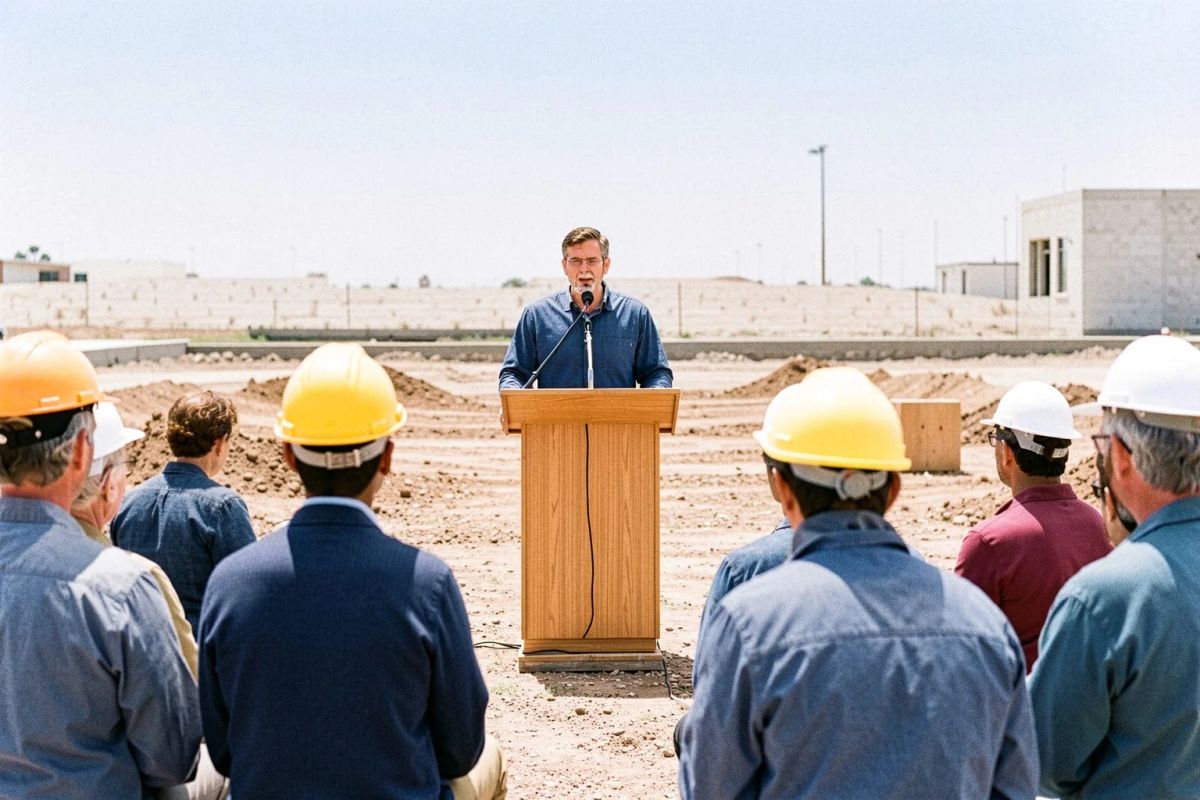
A groundbreaking speech has four parts: a welcome, why the project matters, thank-yous and a look ahead that leads into the symbolic turn of soil. Keep it to a minute for a short remark or three minutes for the main speaker. The sample wording below is original; replace the bracketed placeholders with your own facts.
Section of: Groundbreaking Ceremony: Meaning, Steps and Ideas
All wording is original sample text. Replace [bracketed] items with your own facts, and do not claim anything about the project you cannot support. This page belongs with the overall groundbreaking guide and the planning checklist. For the opening-side version, see the opening-side sample wording, and for a fill-in outline use the speech outline tool.
How do you structure a groundbreaking speech?
Use four parts in order: welcome, why it matters, thanks and look ahead. Each speaker takes one part or a short version of all four.
- Welcome: where we are and what is happening.
- Why it matters: who this serves and what changes.
- Thanks: the specific people and groups.
- Look ahead: what comes next, ending on the cue to turn the soil.
Two rules help every speaker: say names slowly, and stop on time. A short safety note from the site team should come before the first speaker.
What does the welcome sound like?
“Good [morning/afternoon], everyone, and welcome to [site or project name]. I am [name], [role]. We are here today to mark the start of [project], and I am glad you are here for it. Before we begin, [name] from our site team has a short note for us all.”
Safety note (from the site team)
“Thank you. Please stay inside the marked area, follow the instructions of our helpers and the site safety officer, and watch your footing. If you need assistance at any time, please see [name].”
Weather line, if needed
“If the weather changes, we will move to [shelter]. [Name] will tell us if that is needed.”
How do you explain why the project matters?
Say who it serves and what will be different, using facts you can support. Avoid numbers you cannot source.
Sample
“Today we are starting [project], which will [provide / become / bring] [what] to [who]. For years, [community or group] has [needed / asked for / worked toward] this. When it is finished, [what people will be able to do]. That is why we are standing in a field today, and why it is worth it.”
Leave placeholders blank until you have checked the facts with the project team. If you are unsure, make a general statement about the purpose and avoid details.
How do you give the thank-yous?
Name people and say what they did, one sentence each.
“I want to thank [name] and [organization] for [specific contribution]. I want to thank [design team] for [what they did], and [builder] and the crews who will do the work. I want to thank our neighbours, who have [been patient / offered ideas], and everyone here today. This project exists because of you.”
For long lists, thank groups by role aloud and print the full list in the program. Check each spelling and preferred title beforehand.
What do you say as you look ahead to the turn of soil?
Link the future to the symbolic act, then hand over to the host.
“In [time frame, if confirmed with the project team], we hope to see [what it will be]. For now, we begin with a simple step. Would our guests of honor please join [host] at the marked spot.”
Host’s cue
“Thank you. Please stay behind the line while the group gathers. Everyone ready? On three: one, two, three.” [The group turns the soil together.]
Do not mention any time frame, size or cost unless the project team has confirmed it for public use. The symbolic act is a hand action in the marked area only; no guest operates any equipment.
What are the short and long versions?
Sixty-second version
“Welcome, and thank you for being here. We are starting [project], which will [what it does for whom]. Thank you to [names] for making it possible. Now let us begin.”
Three-minute version
Use the four parts above: a welcome of about 20 seconds, the importance of the project in about 60 seconds, thanks in about 60 seconds and the look ahead in about 20 seconds. Rehearse with a timer, as outdoor audiences stand on uneven ground and do not want long remarks.
How do you make it accessible?
Share remarks in print or by captioning on request. The ADA says covered entities must communicate effectively with people who have communication disabilities and provide aids and services when needed. Mention in the invitation how to ask; see the groundbreaking invitation page. Use a microphone, face the audience and keep to the order on the program. For weather, the National Weather Service says that if you hear thunder you are likely within striking distance of the storm, so keep the host ready to pause the program.
See also other formats for the day, which change that change what the speakers do.
People also ask
What do you say at a groundbreaking?
Welcome people, say what is being built and why it matters, thank the people who made it possible and invite everyone into the symbolic moment. Keep to one idea per speaker and say specific names. End with a clear sentence that hands over to the host, who gives the cue for turning the soil. Avoid long project histories.
How long should the speech be?
One minute for a short remark and about three minutes for the main speaker, as editorial examples. Outdoor site events tire a crowd quickly, and guests are standing on uneven ground. If you have more to say, put it in a handout or save it for conversation afterwards. Practise aloud with a timer.
Can I read from notes?
Yes. Large-print notes or index cards are normal, and reading is better than losing your place. Print in a big font, double-spaced, and mark where to pause. Look up at the audience at each full stop. If wind is a risk, use a folder or a card that will not fly away, and bring a second copy.
How do you thank donors or crews?
Name them specifically and say what they did, in one sentence each. Check the spelling and the preferred form of each name in advance. If the list is long, thank groups by role and name only the key ones aloud, and put the full list in the program. Thank crews on site, who are present and appreciate it.
How do you close?
End with a short sentence that looks ahead and then hands to the host, such as 'Now let us begin.' The host then invites the ceremony party to the marked spot and gives the countdown. Do not add new content after the cue. After the soil turn, the host thanks guests and tells them what happens next.
Our sources
- Effective Communication (ADA.gov) (ada.gov)
- Lightning Safety (National Weather Service) (weather.gov)
- Construction (OSHA) (osha.gov)
Related guides
- Groundbreaking Ceremony: Meaning, Steps and Ideas
What a groundbreaking ceremony is, who takes part, the typical sequence, the site-safety rules guests follow and how it differs from real construction.
- Groundbreaking Ceremony Ideas for Projects Big and Small
Groundbreaking ceremony ideas for large and small projects: classic formats, community roles, home builds, nonprofits, bad weather and safety limits.
- Groundbreaking Ceremony Invitation Wording and Samples
Groundbreaking invitation wording: what to include, formal and friendly samples, email and letter versions, site-safety and dress notes, timing and RSVP.
- How to Plan a Groundbreaking Ceremony: Program and Checklist
Plan a groundbreaking ceremony: check with the contractor first, set guests, roles, site safety and access, an example program and a checklist by week.